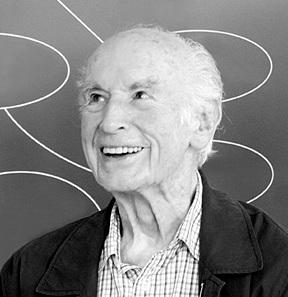
Albert Hofmann
Personal Information
Description
Albert Hofmann was born in Baden, Switzerland, the oldest child of a factory toolmaker. In 1926, he went to the University of Zürich, while working to support his family. His main interest was the chemistry of plants and animals. He graduated in 1929, and received his Ph.D. in Chemistry in 1930. After graduating, Hofmann went to work in the pharmaceutical-chemical department of Sandoz Laboratories, now Novartis, in Basel. In 1938, he made his most famous discovery when he became the first scientist to synthesize lysergic acid (LSD). While working with the chemical in 1943, he accidentally absorbed a small quantity through his fingertips and discovered its powerful effects. Hofmann became director of the natural products department at Sandoz and continued his studies of hallucinogenics. He synthesized psilocybin, the active agent of many magic mushrooms. He traveled to southern Mexico to research other hallucinogens. He advocated for the use of LSD in psychoanalysis, but was critical of the use of it by the Counterculture of the 1960s, which he believe led to its wide prohibition. He wrote about his experiences with and views about LSD in his book LSD: My Problem Child.
Books
LSD
"The pioneering book that identified and explored the unknown landscape and non-ordinary states of human unconscious made visible by LSD"--Provided by publisher.
The Physics of Synchrotron Radiation (Cambridge Monographs on Particle Physics, Nuclear Physics and Cosmology)
LSD, my problem child
Albert Hofmann, who died in 2008 aged 102, first synthesized lysergic acid diethylamide (LSD) in 1938, but the results of animal tests were so unremarkable that the chemical was abandoned. Driven by intuition, he synthesized it again in 1943, and serendipitously noticed its profound effects on himself. Although his work produced other important drugs, including methergine, hydergine and dihydroergotamine, it was LSD that shaped his career. After his discovery of LSD's properties, Hofmann spent years researching sacred plants. He succeeded in isolating and synthesizing the active compounds in the Psilocybe mexicana mushroom, which he named psilocybin and psilocin. During the 60s, Hofmann struck up friendships with personalities such as Aldous Huxley, Gordon Wasson, and Timothy Leary. He continued to work at Sandoz until 1971 when he retired as Director of Research for the Department of Natural Products. He subsequently served as a member of the Nobel Prize Committee, and was nominated by Time magazine as one of the most influential figures of the 20th century. In 2007, Albert Hofmann asked Amanda Feilding if she could publish his Problem Child, and shortly before his death he approved a new and updated translation of his autobiography (first published by McGraw Hill in 1979). It appears here for the first time in print.
Plants of the Gods
The use of hallucinogenic plants has been a part of human experience for millennia, yet modern Western societies have only recently become aware of the significance that these plants have had in shaping the history of diverse cultures. Capable of bringing human beings in closer touch with the spirit worlds, hallucinogenic plants have long been venerated as aids to mental health and as the sacred connection to the mystical. The authors of this definitive book examine the cross-cultural ceremonial and ritual use of many hallucinogenic substances. Profusely illustrated, this book contains an extensively researched plant lexicon, providing common and botanical names, history, ethnography, preparation, chemical components, usage in healing, and effects for 91 hallucinogenic plants.