Discover

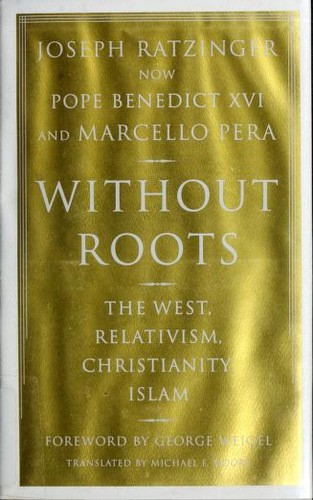
Without Roots

Minsik readers
0.0
0 ratings
Other platforms
0.0
0 ratings
176
PAGES
~2h 56min
READING TIME
English
LANGUAGE
1
READERS
Basic Books 1 views
ISBN
0465006345
1 views
Minsik want to read: 0
Minsik reading: 0
Minsik read: 0
Open Library want to read: 1
Open Library reading: 0
Open Library read: 0

About Author

Joseph Ratzinger

Joseph Alois Ratzinger was born in Marktl, Bavaria, Germany, the son of a police officer. At the age of five, he declared that he wanted to be a cardinal. In 1941, he was conscripted into the Hitler Youth, which was mandatory, although his father believe that Nazism conflicted with the Catholic faith. In 1943, while in seminary, he was drafted into the German anti-aircraft corps, although he deserted in 1945. When he returned home he was imprisoned in a POW camp, and returned to the seminary when he was released after a few months. He was ordained in 1951. In 1958 Ratzinger became a professor of Freising College. He moved to the University of Bonn in 1959, the University of Münster in 1963, and the University of Tübingen in 1966, where he was appointed to a chair in dogmatic theology. While he was at Tübingen he witnessed the student movements of the 1960s, which culminated in disturbances and riots in spring of 1968. Although he was seen as a dogmatic reformist, he believed that the radicalization of the student body was a result of a departure from traditional Catholic teachings. In 1969, Ratzinger was moved to the University of Regensburg in Bavaria. In 1972 he co-founded the theological journal Communio. In 1977, Ratzinger was appointed Archbishop of Munich and Freising. That same year he was named Cardinal-Priest of Santa Maria Consolatrice al Tiburtino by Pope Paul VI. In 1981, Pope John Paul II named Ratzinger Prefect of the Sacred Congregation for the Doctrine of the Faith, and he resigned his post at Munich. In 1993 he became Cardinal Bishop of Velletri-Segni. In 2005, he was elected as the next Pope. He chose for himself the name Pope Benedict XVI.

First sentence

At the beginning of his famous essay, The Protestant Ethic and the Spirit of Capitalism, Max Weber raised the following question: "A product of modern European civilization, studying any problem of universal history, is bound to ask himself to what combination of circumstances the fact should be attributed that in Western civilization, and in Western civilization only, cultural phenomena have appeared which (as we like to think) lie in a line of development having universal significance and value."...

Description

This is Ratzinger's first book as Pope. Written in conjunction with President of the Italian Senate, Marcello Pera--a partnering of the statesman and the holy man--the book is a reassessment of the European "West" and its struggle to define itself in the wake of war, terrorism, diplomatic and spiritual crisis. Pope Benedict reveals a thorough grasp of the contemporary global climate and the tentative and fractious bonds that tie Europe to the rest of the world. Though critical and cautionary, the new Pope ultimately offers an assertive message of hope to mend the West's fractured identity and reconnect with its spiritual roots.--From publisher description.

Detailed Ratings

0.0Emotional Impact
No ratings yet
0.0Intellectual Depth
No ratings yet
0.0Writing Quality
No ratings yet
0.0Rereadability
No ratings yet
0.0Pacing
No ratings yet
0.0Readability
No ratings yet
0.0Plot Complexity
No ratings yet
0.0Humor
No ratings yet