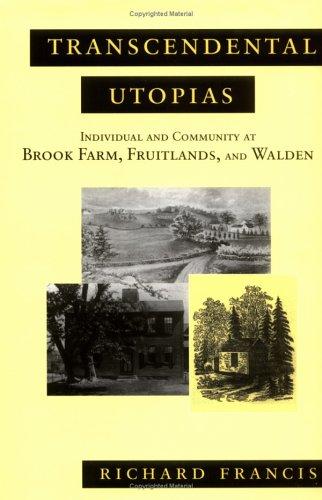
Transcendental utopias
Description
New England Transcendentalism was a vibrant and many-sided movement whose members are probably best remembered for their utopian experiments, their attempts to reconcile the contingent world of history with what they perceived as the stable and patterned world of nature. Richard Francis has written the first book to explore in detail the ideological basis of the three famous experiments during the 1840s: Brook Farm, Fruitlands, and Henry David Thoreau's "community of one" on the shores of Walden Pond. Francis suggests that at the heart of Transcendentalism was a belief that all phenomena are connected in a repetitive sequence. The task was to explain how human society could be reordered to benefit from this seriality. Some members of the movement believed in evolutionary progress, whereas others hoped to be the agents of a sudden millennial transformation. They differed, as well, in their views on whether the fundamental social unit was the individual, the family, the phalanstery, or the community. The story of the three communities was, inevitably, also the story of particular individuals, and Francis highlights the lives and ideas of such leaders as George Ripley, W. H. Channing, Bronson Alcott, Charles Lane, and Theodore Parker.