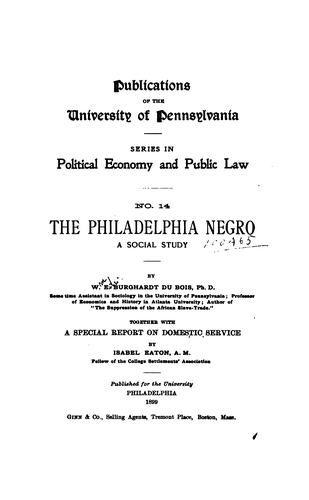
The Philadelphia Negro
Description
In 1897 a young sociologist who was already marked as a scholar of the highest promise submitted to the American Association of Political and Social Sciences a "plan for the study of the Negro problem". The product of that plan was the first great empirical book on the Negro in American society. William Edward Burghardt DuBois (1868-1963), Ph.D. from Harvard (class of 1890), was given a temporary post as Assistant in Sociology at the University of Pennsylvania in order to conduct in-depth studies on the Negro community in Philadelphia. The provost of the university was interested and sympathetic, but DuBois knew early on that white interest and sympathy were far from enough. He knew that scholarship was itself a great weapon in the Negro's struggle for a decent life. The Philadelphia Negro was originally published by the University of Pennsylvania Press in 1899. One of the first works to combine the use of urban ethnography, social history, and descriptive statistics, it has become a classic work in the social science literature. Both the issues the book raises and the evolution of DuBois's own thinking about the problems of black integration into American society sound strikingly contemporary. Among the intriguing aspects of The Philadelphia Negro are what it says about the author, about race in urban America and about social science at the time, but even more important is the fact that many of DuBois's observations can be made - in fact are being made - by investigators today. In his introduction to this edition, Elijah Anderson traces DuBois's life before his move to Philadelphia. He then examines how the neighborhood studied by DuBois has changed over the years, and he compares thestatus of blacks today with their status when the book was initially published.