Richard HofstadterRichard Hofstadter (August 6, 1916 – October 24, 1970) was an American historian and public intellectual. Hofstadter was the DeWitt Clinton Professor of American History at Columbia University. Rejecting his earlier historical materialist approach to history, in the 1950s he came closer to the concept of "consensus history", and was epitomized by some of his admirers as the "iconic historian of postwar liberal consensus." Others see in his work an early critique of the one-dimensional society, since he was equally critical of socialist and capitalist models of society, and bemoaned the "consensus" within the society as "bounded by the horizons of property and entrepreneurship", criticizing the "hegemonic liberal capitalist culture running throughout the course of American history".
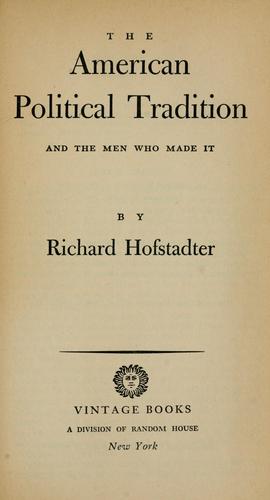
Hofstadter's books include Social Darwinism in American Thought, 1860–1915 (1944); The American Political Tradition (1948); The Age of Reform (1955); Anti-intellectualism in American Life (1963); and the essays collected in The Paranoid Style in American Politics (1964). He was twice awarded the Pulitzer Prize: in 1956 for The Age of Reform, an analysis of the populism movement in the 1890s and the progressive movement of the early 20th century; and in 1964 for the cultural history Anti-intellectualism in American Life.