Discover

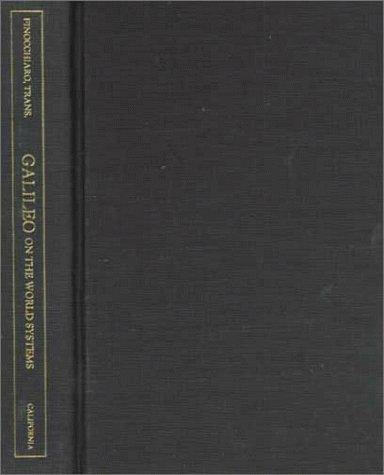
Galileo on the world systems

Minsik readers
0.0
0 ratings
Other platforms
0.0
0 ratings
425
PAGES
~7h 5min
READING TIME
English
LANGUAGE
University of California Press 1 views
ISBN
0520205480, 0520206460
1 views
Minsik want to read: 0
Minsik reading: 0
Minsik read: 0
Open Library want to read: 0
Open Library reading: 0
Open Library read: 0

About Author

Galileo Galilei

The Galileo affair was an early 17th century political, religious, and scientific controversy regarding the astronomer Galileo Galilei's defence of heliocentrism, the idea that the Earth revolves around the Sun. It pitted supporters and opponents of Galileo within both the Catholic Church and academia against each other through two phases: an interrogation and condemnation of Galileo's ideas by a panel of the Roman Inquisition in 1616, and a second trial in 1632 which led to Galileo's house arrest and a ban on his books. In 1610, Galileo published his Sidereus Nuncius (Starry Messenger) describing the observations that he had made with his new, much stronger telescope, amongst them the Galilean moons of Jupiter. With these observations and additional observations that followed, such as the phases of Venus, he promoted the heliocentric theory of Nicolaus Copernicus published in De revolutionibus orbium coelestium in 1543. Galileo's opinions were met with opposition within the Catholic Church, and in 1616 the Inquisition declared heliocentrism to be both scientifically indefensible and heretical.

Description

Galileo's 1632 book, Dialogue on the Two Chief World Systems, Ptolemaic and Copernican, comes alive for twentieth-century readers thanks to Maurice Finocchiaro's brilliant new translation and presentation. Condemned by the Inquisition for its heretical proposition that the earth revolves around the sun, Galileo's masterpiece takes the form of a debate, divided into four Days, among three highly articulate gentlemen. Finocchiaro sets the stage with his Introduction, which not only provides the human and historical framework for the Dialogue but also admits the reader gracefully into the basic non-Copernican understanding of the universe that would have been shared by Galileo's original audience. The translation of the Dialogue is abridged in order to highlight its essential content, and Finocchiaro gives titles to the various parts of the debate as a guide to the principal topics. Focusing on those universal, perennial activities of the human mind that make Galileo's book a living document, Finocchiaro elucidates the mental skills of critical reasoning, methodological reflection, and verbal rhetoric. With an appendix devoted to these activities and their place in the Dialogue, he offers the reader a concrete, hands-on introduction to critical thinking. Galileo on the World Systems is a remarkably nuanced interpretation of a classic work and will give readers the tools to understand and evaluate for themselves one of the most influential scientific books in Western civilization. -- from back cover.

Detailed Ratings

0.0Emotional Impact
No ratings yet
0.0Intellectual Depth
No ratings yet
0.0Writing Quality
No ratings yet
0.0Rereadability
No ratings yet
0.0Pacing
No ratings yet
0.0Readability
No ratings yet
0.0Plot Complexity
No ratings yet
0.0Humor
No ratings yet