Discover

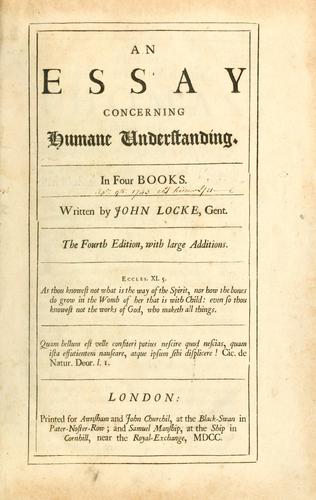
Essay concerning human understanding

Minsik readers
0.0
0 ratings
Other platforms
4.0
7 ratings
601
PAGES
~10h 1min
READING TIME
French
LANGUAGE
3
READERS
Aux dépens de la Compagnie 1 views
ISBN
2711605019
1 views
Minsik want to read: 0
Minsik reading: 0
Minsik read: 0
Open Library want to read: 3
Open Library reading: 0
Open Library read: 0

About Author

John Locke

John Locke, widely known as the Father of Liberalism, was an English philosopher and physician regarded as one of the most influential of Enlightenment thinkers. Considered the first of the British empiricists, he is equally important to social contract theory. His work had a great impact upon the development of epistemology and political philosophy. His writings influenced Voltaire and Rousseau, many Scottish Enlightenment thinkers, as well as the American revolutionaries. His contributions to classical republicanism and liberal theory are reflected in the American Declaration of Independence. Locke's theory of mind is often cited as the origin of modern conceptions of identity and the self, figuring prominently in the work of later philosophers such as Hume, Rousseau and Kant. Locke was the first to define the self through a continuity of consciousness. He postulated that the mind was a blank slate or tabula rasa. Contrary to pre-existing Cartesian philosophy, he maintained that we are born without innate ideas, and that knowledge is instead determined only by experience derived from sense perception.

Description

Locke's Essay ... (1690) withstood an onslaught by traditional theologians, for rejecting orthodox theology and the concept of innate ideas: as he suggested that God could make matter think. The Essay quickly became one of the most influential books of the eighteenth century, and its contributions to the philosophy of space and time, matter and power were quickly hailed as formative contributions to ... philosophy''--Amazon.com.

Detailed Ratings

0.0Emotional Impact
No ratings yet
0.0Intellectual Depth
No ratings yet
0.0Writing Quality
No ratings yet
0.0Rereadability
No ratings yet
0.0Pacing
No ratings yet
0.0Readability
No ratings yet
0.0Plot Complexity
No ratings yet
0.0Humor
No ratings yet
