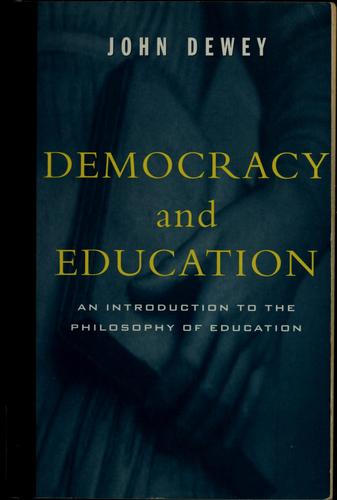
Democracy and Education
Description
Publisher description: John Dewey (1859-1952) believed that learning was active and schooling unnecessarily long and restrictive. His idea was that children came to school to do things and live in a community which gave them real, guided experiences which fostered their capacity to contribute to society. For example, Dewey believed that students should be involved in real-life tasks and challenges: maths could be learnt via learning proportions in cooking or figuring out how long it would take to get from one place to another by mule history could be learnt by experiencing how people lived, geography, what the climate was like, and how plants and animals grew, were important subjects Dewey had a gift for suggesting activities that captured the center of what his classes were studying. Dewey's education philosophy helped forward the "progressive education" movement, and spawned the development of "experiential education" programs and experiments.