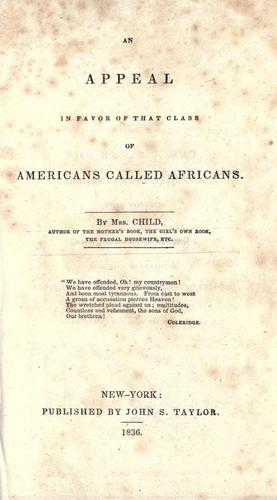
An appeal in favor of that class of Americans called Africans
First sentence
WHILE the Portuguese were exploring Africa, in 1442, Prince Henry ordered Anthony Gonsalez to carry back certain Moorish prisoners, whom he had seized two years before near Cape Bajador: this order was obeyed, and Gonsalez received from the Moors, in exchange for the captives, ten negroes, and a quantity of gold dust...
Description
Published in Boston in 1833, Lydia Maria Child's Appeal provided the abolitionist movement with its first full-scale analysis of race and slavery. Indeed, so comprehensive was its scope, surveying the institution from historical, political, economic, legal, racial, and moral perspectives, that no other antislavery writer ever attempted to duplicate Child's achievement. The Appeal not only denounced slavery in the South but condemned racial prejudice in the free North and refuted racist ideology as a whole. Child's treatise anticipated twentieth-century inquiries into the African origins of European and American culture as well as current arguments against school and job discrimination based on race. This new edition - the first oriented toward the classroom - is enhanced by Carolyn L. Karcher's illuminating introduction. Included is a chronology of Child's life and a list of books for further reading.