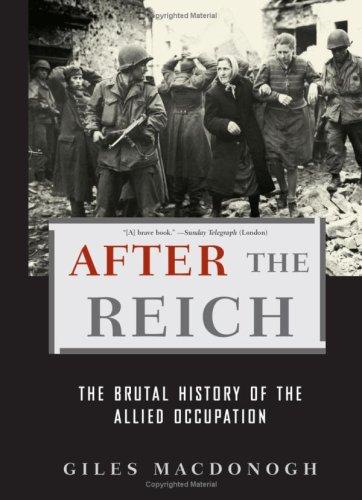
After the Reich
Description
Throughout time it has been the victor who has written history, but here historian MacDonogh (The Last Kaiser: The Life of Wilhelm II, 2001, etc.) examines the darker side of the Allied occupation of defeated Germany. The subtitle is probably the publisher’s, since MacDonogh advises at the outset, “I make no excuses for the crimes the Nazis committed, nor do I doubt for one moment the terrible desire for revenge that they aroused.” In some ways, that revenge was symbolically charged, as when the Allies put concentration camps to use housing prisoners who proved to have more than an accidental connection to the Nazi state; in others it was trivial, as when Russian soldiers went about demanding wristwatches. But aspects of the conquest were brutal indeed: Those Russian soldiers committed revenge rape on a grand scale, while, MacDonogh asserts, the American liberators at Dachau allowed former prisoners to tear guards and kapos limb from limb. More systematically, the Occupation deprived ordinary citizens of their property and, at least for a time, cast everyone under suspicion as tribunals convened and the long process of denazification began. It soon became obvious to almost everyone concerned, not least the occupied Germans, that as the Cold War got colder this process was confined mostly to the small fry; those Germans “were annoyed,” MacDonogh writes, “to see the Party big-shots go free while the authorities continued to harass rank-and-file members who had done nothing monstrous.” So it was that from 1945 until May 1948, when the purge ended, the French, British and American courts had tried 8,000 cases but executed only 806, perhaps half of them civil servants and workers, while the “worst culprits, the operatives who sent thousands to their deaths, were not punished at all.” Of interest to students of modern Europe, complementing W. G. Sebald’s On the Natural History of Destruction (2003) and other studies of history from the point of view of the vanquished.