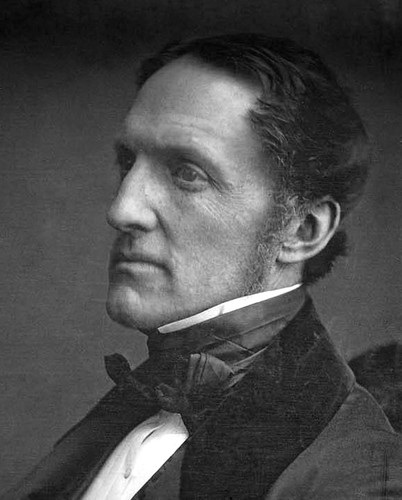

UNITED STATES AUTHOR · HISTORY · INCAS
William Hickling Prescott
Also known as: William H. Prescott
William Hickling Prescott (May 4, 1796 – January 28, 1859) was an American historian and Hispanist, who is widely recognized by historiographers to have been the first American scientific historian. Despite having serious visual impairment, which at times prevented him from reading or writing for himself, Prescott became one of the most eminent historians of 19th-century America. He is also noted for his eidetic memory, also called "photographic memory". After an extensive period of study, during which he sporadically contributed to academic journals, Prescott specialized in late Renaissance Spain and the early Spanish Empire. His works on the subject, The History of the Reign of Ferdinand and Isabella the Catholic (1837), The History of the Conquest of Mexico (1843), A History of the Conquest of Peru (1847) and the unfinished History of the Reign of Phillip II (1856–1858) have become classic works in the field, and have had a great impact on the study of both Spain and Mesoamerica.
Most acclaimed

History of the conquest of Mexico
"The History of the Conquest of Mexico is William Prescott's epic account of Cortes's subjugation of the Aztec people, one that endures as a landmark work of nineteenth-century historiography and dramatic storytelling. Published in ten languages and republished at least two hundred times since its first publication in 1843, it presents a compelling view of the clash of civilizations that reverberates in Latin America to this day. The Conquest of Mexico, judged Prescott's biographer Harry Thurston Peck, is "one of the most brilliant examples which the English language possesses of literary art applied to historical narration," and literary critic Donald A. Ringe calls it "that rare type of book which satisfies fully the demands of both history and art.""--BOOK JACKET.
Complete works
The complete works of Michel de Monaigne, including essays, letters, and travel journals of the father and unsurpassed practitioner of the essay. Humanist, skeptic, acute observer of himself and others, Michel de Montaigne (1533-92) was the first to use the term "essay" to refer to the form he pioneered and he has remained one of its most famous practitioners. He reflected on the great themes of existence in his masterly and engaging writings. His subjects ranging from proper conversation and good reading, to the raising of children and the endurance of pain; from solitude, destiny, time and custom, to truth, consciousness, and death. Having stood the test of time, his essays continue to influence writers nearly five hundred years later. Also included in this complete edition of his works are Montaigne's letters and travel journal, fascinating records of the experiences and contemplations that would shape and infuse his essays. Montaigne speaks to us always in a personal voice in which his virtues of tolerance, moderation, and understanding are dazzlingly manifest. The translation is widely acknowledged to be the classic English version.