Discover
Jan 1, 1795 — Jan 1, 1881· 86 yrs

UNITED KINGDOM OF GREAT BRITAIN AND IRELAND AUTHOR · HISTORY · BIOGRAPHY

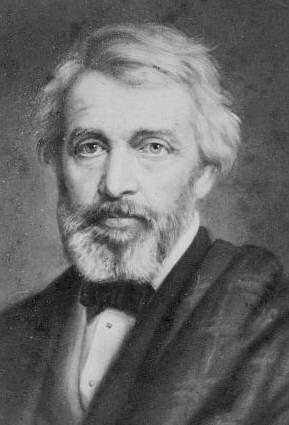
Thomas Carlyle

Also known as: Jane Welsh Carlyle, توماس كارليل

31
BOOKS
4.2
AVG RATING (9)
1
READERS

Thomas Carlyle (4 December 1795 – 5 February 1881) was a Scottish essayist, historian and philosopher. Known as the "sage of Chelsea", his writings strongly influenced the intellectual and artistic culture of the Victorian era. Carlyle was born in Ecclefechan, a village in Dumfriesshire. He attended the University of Edinburgh, where he excelled in mathematics and invented the Carlyle circle. After finishing the school's arts course, he prepared to become a minister in the Burgher Church while working as a schoolmaster.

Ecclefechan, United Kingdom of Great Britain and Ireland
Wikipedia

So far we have examined the different ways in which successive generations of historians have interpreted the French Revolution; we have also discussed its origins and examined the question of why the Revolution broke out in France when it did.

— from ... The French Revolution, 1897

Most acclaimed

#1

Chartism

0.0 (0)
#2

... The French Revolution

1897

3.0 (1)

The book that established Thomas Carlyle's reputation when first published in 1837, this spectacular historical masterpiece has since been accepted as the standard work on the subject. It combines a shrewd insight into character, a vivid realization of the picturesque, and a singular ability to bring the past to blazing life, making it a reading experience as thrilling as any novel. As John D. Rosenberg observes in his Introduction, The French Revolution is "one of the grand poems of [Carlyle's] century, yet its poetry consists in being everywhere scrupulously rooted in historical fact."--Publisher.

#3

Letters

0.0 (0)

"A landmark of postmodern American fiction, Letters is (as the subtitle genially informs us) "an old time epistolary novel by seven fictitious drolls & dreamers each of which imagines himself factual." Seven characters (including the Author himself) exchange a novel's worth of letters during a 7-month period in 1969, a time of revolution that recalls the U.S.'s first revolution in the 18th century - the heyday of the epistolary novel. Recapitulating American history as well as the plots of his first six novels, Barth's seventh novel is a witty and profound exploration of the nature of revolution and renewal, rebellion and reenactment, at both the private and public levels. It is also an ingenious meditation on the genre of the novel itself, recycling an older form to explore new directions, new possibilities for the novel."--BOOK JACKET.

Books

Newest First