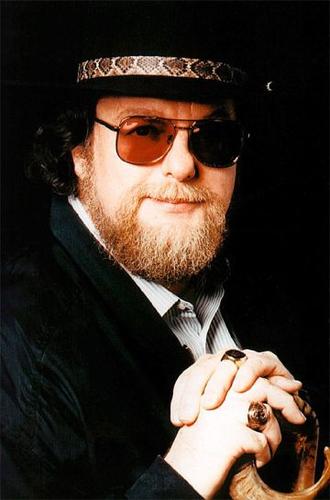

UNITED STATES AUTHOR · FICTION · FANTASY FICTION
Robert Jordan
Also known as: Chang Lung, Reagan O'Neal
James Oliver Rigney Jr. (October 17, 1948 – September 16, 2007), known by his pen name Robert Jordan, was an American author known for his epic fantasy series The Wheel of Time. Born in Charleston, South Carolina, Jordan developed a passion for storytelling and served two tours in Vietnam before pursuing a writing career in 1977. Jordan is best known for The Wheel of Time, a sprawling fantasy saga that combines intricate world-building, complex characters, and a richly detailed magic system. The series spans fourteen books and a prequel novel, with the first volume, [The Eye of the World], published in 1990. The narrative explores themes of prophecy, destiny, and the struggle between good and evil, set in a meticulously crafted world with its own history, cultures, and languages. After Jordan's passing in 2007, fellow fantasy author [Brandon Sanderson]was chosen to complete the series using Jordan's extensive notes and outlines. The final three books were published between 2009 and 2013, bringing the epic saga to a conclusion. Jordan was one of several writers who contributed to the Conan the Barbarian series, with his works considered among the best by fans. He wrote seven Conan novels, and compiled a well-known Conan Chronology. In addition to his fantasy writing, Jordan used various pseudonyms for different genres: Reagan O'Neal for historical novels set during the American Revolution, Jackson O'Reilly for a western novel, and Chang Lung for his dance and theater criticism. Jordan's ability to create immersive worlds and compelling characters has earned him a dedicated fan base and numerous accolades. His work on The Wheel of Time series has sold over 90 million copies worldwide and was adapted into a television series by Amazon Prime Video in 2021. His favorite authors included: [Robert A. Heinlein], [John D. MacDonald], [Louis L'Amour], [Jane Austen], [Charles Dickens], [Mark Twain], and [Montaigne]. Fantasy authors he enjoyed included: [Tad Williams], [Robert Holdstock], [Raymond E. Feist], [Janny Wurts], [Barry Hughart], and [C. S. Friedman]. (Sources:,,)
The Wheel of Time turns, and Ages come and pass, leaving memories that become legend.
— from The Shadow Rising, 1992
Most acclaimed

The Path of Daggers
1998
From Publishers Weekly The eighth book of Jordan's bestselling The Wheel of Time saga (A Crown of Swords, etc.) opens with a renewed invasion by the Seanchans, a conquering race whose arsenal includes man-carrying flying reptiles and enslaved female magic-workers as well as powerful soldiers, many of whom have joined the Seanchans out of fear of the Dragon Reborn. The Dragon himself, Rand al'Thor, appears in only a small part of the narrative, but during that time he endures the ugly experience of seeing his magic kill his friends, heightening his fear that his destiny is to slay everyone he cares about. The first third of the book is a little slower paced than is usual for Jordan, emphasizing the growth of relationships, but the action picks up soon enough. More compact than some previous volumes in the saga, this one has the virtues readers have come to expect from the author: meticulous world-building; deft use of multiple viewpoints; highly original and intelligent systems of magic; an admirable wit; and a continuous awareness of the fate of the turnip farmer or peddler caught in the path of the heroes' armies. Unlike some authors of megasagas, Jordan chooses his words with care, creating people and events that have earned him an enormous readership. For sheer imagination and storytelling skill, if not quite for mythic resonance, The Wheel of Time now rivals Tolkien's The Lord of the Rings.
Lord of Chaos
The Wheel of Time turns and Ages come and go, leaving memories that become legend. Legend fades to myth, and even myth is long forgotten when the Age that gave it birth returns again. In the Third Age, an Age of Prophecy, the World and Time themselves hang in the balance. What was, what will be, and what is, may yet fall under the Shadow. On the slopes of Shayol Ghul, the Myrddraal swords are forged, and the sky is not the sky of this world; In Salidar the White Tower in exile prepares an embassy to Caemlyn, where Rand Al'Thor, the Dragon Reborn, holds the throne--and where an unexpected visitor may change the world.... In Emond's Field, Perrin Goldeneyes, Lord of the Two Rivers, feels the pull of ta'veren to ta'veren and prepares to march... Morgase of Caemlyn finds a most unexpected, and quite unwelcome, ally....And south lies Illian, where Sammael holds sway... TV series update: "Sony will produce along with Red Eagle Entertainment and Radar Pictures. Rafe Judkins is attached to write and executive produce. Judkins previously worked on shows such as ABC’s “Agents of SHIELD,” the Netflix series “Hemlock Grove,” and the NBC series “Chuck.” Red Eagle partners Rick Selvage and Larry Mondragon will executive produce along with Radar’s Ted Field and Mike Weber. Darren Lemke will also executive produce, with Jordan’s widow Harriet McDougal serving as consulting producer." —Variety The Wheel of Time® New Spring: The Novel #1 The Eye of the World #2 The Great Hunt #3 The Dragon Reborn #4 The Shadow Rising #5 The Fires of Heaven #6 Lord of Chaos #7 A Crown of Swords #8 The Path of Daggers #9 Winter's Heart #10 Crossroads of Twilight #11 Knife of Dreams By Robert Jordan and Brandon Sanderson #12 The Gathering Storm #13 Towers of Midnight #14 A Memory of Light
The Gathering Storm
2009
One of the most fascinating works of history ever written, Winston's Churchill's monumental The Second World War is a six-volume account of the struggle of the Allied powers in Europe against Germany and the Axis. Told through the eyes of British Prime Minister Winston Churchill, The Second World War is also the story of one nation's singular, heroic role in the fight against tyranny. Pride and patriotism are evident everywhere in Churchill's dramatic account and for good reason. Having learned a lesson at Munich that they would never forget, the British refused to make peace with Hitler, defying him even after France had fallen and after it seemed as though the Nazis were unstoppable. Churchill remained unbowed throughout, as did the people of Britain in whose determination and courage he placed his confidence. Patriotic as Churchill was, he managed to maintain a balanced impartiality in his description of the war. What is perhaps most interesting, and what lends the work its tension and emotion, is Churchill's inclusion of a significant amount of primary material. We hear his retrospective analysis of the war, to be sure; but we are also presented with memos, letters, orders, speeches, and telegrams that give a day-by-day account of the reactions—both mistaken and justified—to the unfolding drama. Strategies and counterstrategies develop to respond to Hitler's ruthless conquest of Europe, his planned invasion of England, and his treacherous assault on Russia. It is a mesmerizing account of the crucial decisions that have to be made with imperfect knowledge and an awareness that the fate of the world hangs in the balance. The Gathering Storm is the first volume of The Second World War. In some ways a continuation of The World Crisis, Churchill's history of World War I, The Gathering Storm is his attempt to come to grips with the terrible circumstances that gave rise to Nazi Germany and a second, even more destructive world conflict. As he notes in his preface, Churchill was perhaps the only person who held such prominent positions of power in both world wars, so he is remarkably well-qualified to tell the tragic story of war to peace to war. The Gathering Storm considers the stipulations and consequences of the Treaty of Versailles, the rise of Adolf Hitler, the capitulation at Munich and the entry of the British into the war. The volume is pervaded by Churchill's somber feeling that the Second World War was largely a senseless and avoidable conflict, but it sets the stage for the heroism and glory that are to follow. Churchill won the Nobel Prize for Literature in 1953 due in no small part to this awe-inspiring work.