
UNITED KINGDOM OF GREAT BRITAIN AND IRELAND AUTHOR · HISTORY · POLITICS AND GOVERNMENT
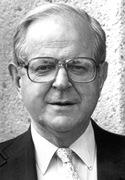
Robert Conquest
Robert Conquest was born in Malvern, Worcestershire, the son of an American businessman and a Norwegian mother. He was educated at Winchester College, the University of Grenoble, Oxford University, where he was an exhibitioner in modern history and took his bachelor's and master's degrees in Philosophy, Politics and Economics, and his doctorate in Soviet history. In 1937, after a year studying at the University of Grenoble and traveling in Bulgaria, he returned to Oxford and joined the Communist Party. When When World War II began, he became an intelligence officer in the Light Infantry. In 1940, he married Joan Watkins, with whom he had two sons. In 1944, while posted to Bulgaria as a liaison officer to the Bulgarian forces fighting under Soviet command, he met Tatiana Mihailova, who later became his second wife. After the war, he became the press officer at the British embassy in Sofia, Bulgaria, where he witnessed the gradual rise of Soviet communism in the country, and he became disillusioned with communism. He returned to London, helping Tatiana escape at the same time, divorced his first wife and married Tatiana. He joined a branch of the Foreign Office, then left in 1956 to become a freelance writer and historian. His first books, Power and Politics in the USSR and Soviet Deportation of Nationalities, were published in 1960. In addition to historical works, he also published science fiction. In 1962, he was divorced from his second wife and in 1964 he married again, but this marriage was dissolved in 1978 and in 1979 he married his fourth wife. In 1981, he moved to California where he is currently a Research Fellow at the Hoover Institution at Stanford University. Conquest is now senior research fellow and scholar-curator of the Russian and Commonwealth of Independent States Collection at the Hoover Institution. He is also an adjunct fellow of the Center for Strategic and International Studies in Washington, D.C., and a former research associate of Harvard University's Ukrainian Research Institute. He is a member of the board of the Institute for European Defence and Strategic Studies. He is a fellow of the British Interplanetary Society and a member of the Society for the Promotion of Roman Studies and the American Association for the Advancement of Slavic Studies.
WHO stands on that cliff, like a figure of stone,
— from Poems
Most acclaimed

Present danger
To Love He'll find her. Sooner or later, Aunie Franklin's ex-husband, Wesley, will track her down. She's moved clear across the country to start over, but she knows it's not far enough from a madman obsessed with making her pay. . . And To Cherish James Ryder's new tenant is running from something. Her Southern sass doesn't hide the fading bruises on her face. James doesn't need more complications in his life, but he can't ignore her rising fear. Especially once the phone calls and threats begin. . . Till Death. . . Every day brings Wesley one step closer. Aunie will be his again, to possess—and to punish. Because the past she tried to flee is about to become her present. And he'll make sure she never escapes again. . .
Stalin
"A magnificent new biography that revolutionizes our understanding of Stalin and his world. It has the quality of myth: a poor cobbler's son, a seminarian from an oppressed outer province of the Russian empire, reinvents himself as a top leader in a band of revolutionary zealots. When the band seizes control of the country in the aftermath of total world war, the former seminarian ruthlessly dominates the new regime until he stands as absolute ruler of a vast and terrible state apparatus, with dominion over Eurasia. While still building his power base within the Bolshevik dictatorship, he embarks upon the greatest gamble of his political life and the largest program of social reengineering ever attempted: the collectivization of all agriculture and industry across one sixth of the earth. Millions will die, and many more millions will suffer, but the man will push through to the end against all resistance and doubts. Where did such power come from? In Stalin, Stephen Kotkin offers a biography that, at long last, is equal to this shrewd, sociopathic, charismatic dictator in all his dimensions. The character of Stalin emerges as both astute and blinkered, cynical and true believing, people oriented and vicious, canny enough to see through people but prone to nonsensical beliefs. We see a man inclined to despotism who could be utterly charming, a pragmatic ideologue, a leader who obsessed over slights yet was a precocious geostrategic thinker--unique among Bolsheviks--and yet who made egregious strategic blunders. Through it all, we see Stalin's unflinching persistence, his sheer force of will--perhaps the ultimate key to understanding his indelible mark on history. Stalin gives an intimate view of the Bolshevik regime's inner geography of power, bringing to the fore fresh materials from Soviet military intelligence and the secret police. Kotkin rejects the inherited wisdom about Stalin's psychological makeup, showing us instead how Stalin's near paranoia was fundamentally political, and closely tracks the Bolshevik revolution's structural paranoia, the predicament of a Communist regime in an overwhelmingly capitalist world, surrounded and penetrated by enemies. At the same time, Kotkin demonstrates the impossibility of understanding Stalin's momentous decisions outside of the context of the tragic history of imperial Russia. The product of a decade of intrepid research, Stalin is a landmark achievement, a work that recasts the way we think about the Soviet Union, revolution, dictatorship, the twentieth century, and indeed the art of history itself"--
Poems
This is an edition of all the known poems of Mark Akenside, the eighteenth-century English poet and physician, whose poetry has not been newly edited for more than a century. This edition will thus provide scholars and students with a much-needed opportunity to reassess the extent of Akenside's contribution to literary culture, and it will also clarify his role in the development of the aesthetic theories of his own generation and the one that followed. The career of Mark Akenside (1721-70) spans a period of extraordinarily fast change in English literature: his first major poem, The Pleasures of Imagination, appeared in the year of Pope's death; and Akenside died in the year Wordsworth was born. His works not only reflected the very considerable changes that took place during these years; they also contributed in many ways to the shifts in focus, interest, and emphasis that characterize the literature of the later eighteenth century. Akenside's fascination with the imagination, its characteristics and functions, resulted in an intriguing and influential blend of the poetic and the philosophical in his longer poems, The Pleasures of Imagination (1744) and The Pleasures of the Imagination (1772). The earlier work explores the then new subject of aesthetics in greater detail than it had ever been explored before, presenting various original insights and arguments. Yet it would be wrong to see the poem as merely a versified philosophical treatise; its complex structure offers satisfactions beyond those of sequential logic, and the examples cited to illustrate the central ideas are imbued with considerable vigor and clarity. As products of, and contributors to, the eighteenth-century enthusiasm for aesthetics, Akenside's longer poems are captivating examples of the eighteenth- and nineteenth-century experiment in developing the philosophical poem into a major literary form. It is for this reason above all others that they are valued by Coleridge and the writers of the next generation. Because of the comparative obscurity into which Akenside's works fell after the demise of the long philosophical poem in the latter part of the nineteenth century, they have not by and large attracted the attention of modern bibliographers. In this edition numerous bibliographical and textual puzzles presented by his poems are solved for the first time. The apparatus, meanwhile, demonstrates the full extent of the poet's urge to revise - an urge that extended from the wholesale rewriting of some poems to subtle alterations of textual minutiae, showing a mind and an ear alive to nuances of meaning and intonation.