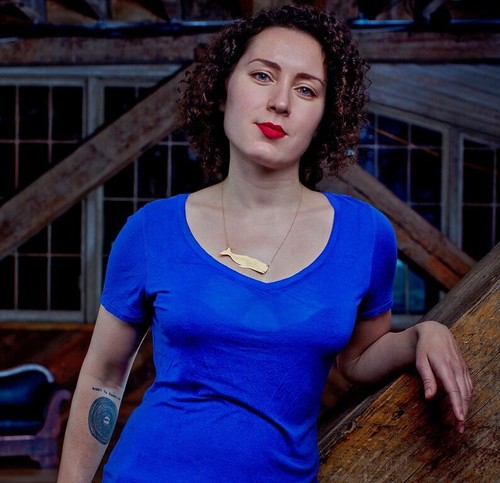

Maria Popova
Author of The Marginalian (formerly Brain Pickings) Maria Popova is a Bulgarian-born, American-based essayist, book author, poet, and writer of literary and arts commentary and cultural criticism that has found wide appeal both for her writing and for the visual stylistics that accompany it. In 2006, she started the blog Brain Pickings, an online publication that she has fought to maintain advertisement-free. The blog, renamed to The Marginalian upon its 15th birthday in 2021, features her writing on books, the arts, philosophy, culture, and other subjects. In addition to her writing and related speaking engagements, she has served as an MIT Futures of Entertainment Fellow, as the editorial director at the higher education social network Lore, and has written for The New York Times, The Atlantic, Wired UK, and other publications. Since 2010, she has resided in Brooklyn, New York. She is the creator of "The Universe in Verse", a large-scale, multimedia annual celebration of science and the natural world through poetry.
Most acclaimed

Russia and Ukraine
In February 2022, Russian missiles rained on Ukrainian cities, and tanks rolled towards Kyiv to end Ukrainian independent statehood. President Zelensky declined a Western evacuation offer and Ukrainians rallied to defend their country. What are the roots of this war, which has upended the international legal order and brought back the spectre of nuclear escalation? How did these supposedly “brotherly peoples” become each other’s worst nightmare? In Russia and Ukraine: Entangled Histories, Diverging States, Maria Popova and Oxana Shevel explain how since 1991 Russia and Ukraine diverged politically, ending up on a collision course. Russia slid back into authoritarianism and imperialism, while Ukraine consolidated a competitive political system and pro-European identity. As Ukraine built a democratic nation-state, Russia refused to accept it and came to see it as an “anti-Russia” project. After political and economic pressure proved ineffective, and even counterproductive, Putin went to war to force Ukraine back into the fold of the “Russian world.” Ukraine resisted, determined to pursue European integration as a sovereign state. These irreconcilable goals, rather than geopolitical wrangling between Russia and the West over NATO expansion, are – the authors argue – essential to understanding Russia’s war on Ukraine.