Juan Luis Vives
Personal Information
Description
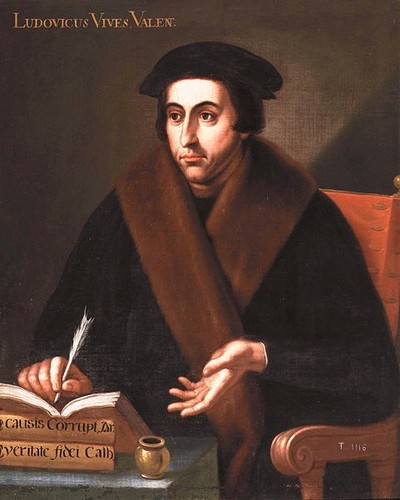
A Valencian scholar and humanist who spent most of his adult life in the Southern Netherlands. His beliefs on the soul, insight into early medical practice, and perspective on emotions, memory and learning earned him the title of the "father" of modern psychology (Wikipedia).
Books
De subventione pauperum, sive, De humanis necessitativus libri II
Tratado del socorro de los pobres, cuyo nombre original en latín es De subventione pauperum. Sive de humanis necessitatibus libri II (De la subvención a los pobres o sobre los humanos necesitados libro II), es un libro escrito por el humanista español Juan Luis Vives, y publicado en Brujas en 1526. La obra se divide en dos libros, dedicados respectivamente al "Origen de la necesidad y miseria del hombre" (I) y "Cuanto conviene a los gobernadores de la república cuidar a los pobres" (II). Propone un completo conjunto de medidas para prevenir y evitar la mendicidad, así como regular la actuación de las instituciones cívicas encargadas de ello. Desde una perspectiva cristiana, insiste en que lo que Dios da a cada uno no se lo da para él solo, y de que no puede haber verdadera piedad sin el socorro o beneficencia recíproca. También señala la necesidad del trabajo y la formación y educación, como principales remedios para solventar la pobreza de la ciudad; se debe tratar de identificar a los verdaderos pobres de los falsos, y todos aquellos capacitados para trabajar deben hacerlo en beneficio propio y de la comunidad. La obra fue muy divulgada e influyente, siendo traducida a diversas lenguas.
The instruction of a Christen woman
"This edition of The Instruction of a Christen Woman is the first to provide the modern reader with the complete text of the single most influential book in Tudor England concerning women and how they should live their lives.". "This old-spelling edition of The Instruction of a Christen Woman includes a substantial introduction that sets the book within its biographical, historical, and generic contexts and establishes its history as a printed text in eight succeeding sixteenth-century editions that reflect the social, religious, and political changes of that age."--BOOK JACKET.
Obras políticas y pacifistas
Recopilación de obras políticas y pacifistas de Juan Luis Vives.
De comunione rerumde / De subventione pauperum
En El socorro de los pobres y La comunicación de bienes, Juan Luis Vives aborda la teoría y la praxis del derecho de propiedad. Las dos constituyen un tratado sobre la propiedad privada y sus funciones, la individual y la social. Presenta Vives de manera expresa la proyección práctica de sus teorías sobre los bienes en la activa sociedad de Brujas, con la primera obra; y con la segunda, aborda un importante problema surgido en la llamada Germania Inferior, la sublevación de los anabaptistas. El socorro de los pobres versa sobre lo que en terminología actual denominamos «función social» de la propiedad privada. En La comunicación de bienes defiende el derecho de propiedad privada contra la colectivización o cualquier tipo de comunismo.
De institutione feminae Christianae
Vives' tract on the eduction of women, De Institutione Feminae Christianae (1524, revised 1538) became a model for conduct books in various Protestant traditions and as such has always been of interest to historians of education. However, the treatise also made a very important contribution to the querelle des femmes of its time and has consequently generated much interest among modern historians of women and gender. It consists of 3 books, one for each stage of woman's life - maidenhood, marriage and widowhood. The only English translation of the text on offer till now was the inaccurate and free version of Richard Hyrde (a friend of Thomas More), published early in the 10th century by Foster Watson, but now unavailable. This edition offers a new Latin text with a double apparatus and a facing-page English translation with notes, with an introduction to the edition and the text. Volume I (1996) contains Book I, volume 2 covers Books II-III.
Concerning the Relief of the Poor; or, Concerning Human Need
Letter addressed to the Senate of Bruges by Juan-Luis Vives on January 6, 1526. Vives' ideas on the relief of the poor from a single integrated system based on the various practices already in use in northern Europe foreshadowed the English Poor Laws of 1601 and the later laws of the New World.
