
UNITED STATES AUTHOR · FICTION · CHILDREN
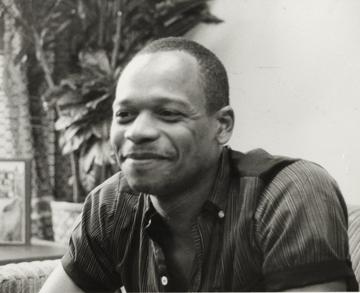
John Steptoe
John Lewis Steptoe, creator of award-winning picture books for children, was born in Brooklyn on September 14, 1950 and was raised in the Bedford-Stuyvesant section of that borough. He began drawing as a young child and received his formal art training at the High School of Art and Design in Manhattan. He was a student in the HARYOU-ACT Art Program and instructed by the highly recognized African American oil painter, Norman Lewis. He continued his studies at the Vermont Academy, where he was instructed by sculptor John Torres, and by William Majors, a painter acclaimed by the Museum of Modem Art for his etchings and printmaking. His work first came to national attention in 1969 when his first book, STEVIE, appeared in its entirety in Life magazine, hailed as "a new kind of book for black children." Mr. Steptoe, who had begun work on Stevie at the age of 16, was then 18 years old. In his twenty-year career, Mr. Steptoe illustrated sixteen picture books, twelve of which he also wrote. The American Library Association named two of his books Caldecott Honor Books, a prestigious award for children's book illustration: THE STORY OF JUMPING MOUSE in 1985 and MUFARO'S BEAUTIFUL DAUGHTERS in 1988. Mr. Steptoe twice received the Coretta Scott King Award for Illustration, for MOTHER CROCODILE (text by Rosa Guy) in 1982, and for MUFARO'S BEAUTIFUL DAUGHTERS in 1988. While all of Mr. Steptoe's work deals with aspects of the African American experience, MUFARO'S BEAUTIFUL DAUGHTERS was acknowledged by reviewers and critics as a breakthrough. Based on an African tale recorded in the 19th century, it required Mr. Steptoe for the first time to research African history and culture, awakening his pride in his African ancestry. Mr. Steptoe hoped that his books would lead children, especially African American children, to feel pride in their origins and in who they are. "I am not an exception to the rule among my race of people," he said, accepting the Boston Globe/Horn Book Award for Illustration, "I am the rule. By that I mean there are a great many others like me where I come from." Mr. Steptoe frequently spoke to audiences of children and adults about his work. He was the 1989 winner of the Milner Award, voted by Atlanta schoolchildren for their favorite author. John Steptoe died on August 28, 1989 at Saint Luke's Hospital in Manhattan, following a long illness. He was 38 years old and lived in Brooklyn. Mr. Steptoe was among the handful of African American artists who have made a career in children's books. Biography from official John Steptoe site at Used with permission.
One day my momma told me, "You know you're gonna have a little friend come stay with you."
— from Stevie, 1969
Most acclaimed

Daddy Is a Monster...Sometimes
1980
Young Bweela and Javaka test the boundaries of proper behavior growing up in a loving one parent home.
Stevie
1969
A little boy named Stevie comes to visit. Robert an only child begrudgingly has to take little Stevie with him everywhere he goes. At first annoyed when it is time for Stevie to leave Robert misses him.
Creativity
This book is about what makes life worth living. The creative excitement of the artist at her easel or the scientist in the lab comes as close to the ideal fulfillment as we all hope to, and so rarely do. Professor Mihaly Csikszentmihalyi interviewed more than ninety of possibly the most interesting people in the world - people like actor Ed Asner, authors Robertson Davies and Nadine Gordimer, scientists Jonas Salk and Linus Pauling, and Senator Eugene McCarthy - who have changed the way people in their fields think and work to find out how creativity has been a force in their lives. In his bestselling book Flow, Professor Csikszentmihalyi explored states of "optimal experience" - those times when people report feelings of concentration and deep enjoyment - and showed that what makes experience genuinely satisfying is a state of consciousness called "flow." Here Professor Csikszentmihalyi builds on his flow theory, profiling individuals who have found ways to make flow a permanent feature of their lives and at the same time have contributed to society and culture. This book is not so much about the everyday "creativity" that we all experience but the kind of creativity of artists, scientists, and others that can transform our culture and the way we look at the world. By studying the creative lives of exceptional people, Professor Csikszentmihalyi shows us how we can all enhance our everyday lives. His goal is to help us better understand a way of being that is more satisfying and more fulfilling.