
UNITED STATES AUTHOR · FICTION · SCIENCE FICTION
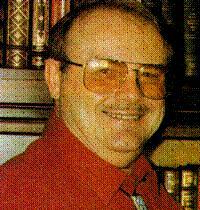
Jerry Pournelle
Also known as: Jerry E. Pournelle, J. Pournelle
Jerry Eugene Pournelle (; August 7, 1933 – September 8, 2017) was an American scientist in the area of operations research and human factors research, a science fiction writer, journalist, and one of the first bloggers. In the 1960s and early 1970s, he worked in the aerospace industry, but eventually focused on his writing career. In an obituary in Gizmodo, he was described as "a tireless ambassador for the future." Pournelle's hard science fiction writing received multiple awards. In addition to his solo writing, he wrote several novels with collaborators including Larry Niven. Pournelle served a term as President of the Science Fiction and Fantasy Writers of America.
"Admiral's compliments, and you're to come to his office right away," Midshipman Staley announced.
— from The Mote in God's Eye
Most acclaimed

Inferno
2008
From one of our finest military historians, a monumental work that shows us at once the truly global reach of World War II and its deeply personal consequences. World War II involved tens of millions of soldiers and cost sixty million lives -- an average of twenty-seven thousand a day. For thirty-five years, Max Hastings has researched and written about different aspects of the war. Now, for the first time, he gives us a magnificent, single-volume history of the entire war. Through his strikingly detailed stories of everyday people -- of soldiers, sailors and airmen; British housewives and Indian peasants; SS killers and the citizens of Leningrad, some of whom resorted to cannibalism during the two-year siege; Japanese suicide pilots and American carrier crews—Hastings provides a singularly intimate portrait of the world at war. He simultaneously traces the major developments—Hitler's refusal to retreat from the Soviet Union until it was too late; Stalin's ruthlessness in using his greater population to wear down the German army; Churchill's leadership in the dark days of 1940 and 1941; Roosevelt's steady hand before and after the United States entered the war—and puts them in real human context. Hastings also illuminates some of the darker and less explored regions under the war's penumbra, including the conflict between the Soviet Union and Finland, during which the Finns fiercely and surprisingly resisted Stalin's invading Red Army; and the Bengal famine in 1943 and 1944, when at least one million people died in what turned out to be, in Nehru's words, "the final epitaph of British rule" in India. Remarkably informed and wide-ranging, Inferno is both elegantly written and cogently argued. Above all, it is a new and essential understanding of one of the greatest and bloodiest events of the twentieth century. - Publisher.
The Mote in God's Eye
Science fiction classic about the rise, fall and subsequent rise of a civilization where the peak catastrophe is known as the "crazy eddy point". Introduces the concept of frictionless toilets that don't have any water in them but I suspect the authors didn't think it all the way through - I don't recall a negative air pressure that would keep odours in their rightfull place. Nevertheless a fascinating read. I haven't read this for donkeys years which is why I'm searching for an e-copy.
Lucifer's Hammer
Lucifer's Hammer is a post-apocalyptic science fiction novel by Larry Niven and Jerry Pournelle, first published in 1977. It was nominated for the Hugo Award for Best Novel in 1978. The story details a cometary impact on Earth, an end to civilization, and the battle for the future. It encompasses the discovery of the comet, the LA social scene, and a cast of diverse characters whom fate seems to smile upon and allow to survive the massive cataclysm and the resulting tsunamis, plagues, famines and battles amongst scavengers and cannibals.