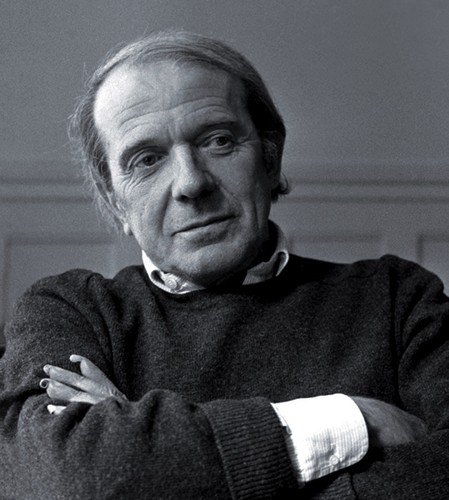

FRANCE AUTHOR · PHILOSOPHY · CRITICISM AND INTERPRETATION
Gilles Deleuze
Also known as: Deleuze, Gilles., Deleuze Gilles
Gilles Louis René Deleuze (18 January 1925 – 4 November 1995) was a French philosopher who, from the early 1950s until his death in 1995, wrote on philosophy, literature, film, and fine art. His most popular works were the two volumes of Capitalism and Schizophrenia: Anti-Oedipus (1972) and A Thousand Plateaus (1980), both co-written with psychoanalyst Félix Guattari. His metaphysical treatise Difference and Repetition (1968) is considered to be his magnum opus. An important part of Deleuze's oeuvre is devoted to the reading of other philosophers: the Stoics, Leibniz, Hume, Kant, Nietzsche, Spinoza, and Bergson. A. W. Moore, citing Bernard Williams's criteria for a great thinker, ranks Deleuze among the "greatest philosophers".
What is philosophy? In a sense, we all can answer that question, as philosophy is meant for everyone. We may make of it as little or as much as we please. But the more we make of philosophy, the more seriously we must take it. This book is for those who want to take a serious look at philosophy without necessarily becoming serious philosophers.
— from What is philosophy?
Most acclaimed

Nietzsche
"In his Blistering Prose, Friedrich Nietzsche (1844-1900) uprooted the traditional study of philosophy as firmly grounded in rationality and truth and lay the foundations for the radicalism of twentieth-century Western thought, as it would emerge after his death. Contemporary thinkers have reinterpreted, revised, and repeated Nietzsche's ideas, but no one has transcended them, and today, no student of philosophy can afford to ignore the life and work of this towering figure. In his seminal work, acclaimed biographer Rudiger Safranski integrates philosophical analysis with biographical detail to portray this difficult, often contradictory man with an objective, even-handed grace." "Following Nietzsche's own dictum that "life is a testing ground for thought," Safranski, the author of biographies of Heidegger and Schopenhauer, offers a critical reappraisal of Nietzsche's philosophy by examining the intersection of his life and work, attempting what Nietzsche considered the most important of human tasks: to be "an adventurer, a circumnavigator of the inner world called human.""--BOOK JACKET
What is philosophy?
Called by many France's leading intellectual, Gilles Deleuze is one of the most important philosophers in the Western world. His acclaimed works and celebrated collaborations with Felix Guattari have established him as a seminal figure in the fields of philosophy, cultural studies, and literary theory. The publication of What Is Philosophy? marks the culmination of Deleuze's career. Deleuze and Guattari situate philosophy in the realm of problems and possibilities. The book presents a revolutionary theory of philosophy and in the process develops a new understanding of the interrelationships among philosophy, science, and the arts. The authors differentiate philosophy from science and the arts, seeing each domain as a means of confronting chaos, and challenging the common view that philosophy is an extension of logic. They discuss the similarities and distinctions between creative and philosophical writing. Fresh anecdotes from the history of philosophy illuminate the book, along with engaging discussions of composers, painters, writers, and architects. . A milestone in Deleuze's collaboration with Guattari, What Is Philosophy? brings new perspectives to Deleuze's studies of cinema, literature, painting, and music, while setting a brilliant capstone upon his intellectual corpus. Newcomers to the two thinkers' writings will relish the book's scope, energy, and inventiveness; veteran followers will appreciate Deleuze and Guattari's fierce determination to grasp the elusive meaning of philosophy in this, their last and most remarkable joint effort.
Francis Bacon
1974
The portrait Bowen paints of this controversial man, Francis Bacon (1561-1626), balances the outward life and actions of Bacon with the seemingly contradictory aspects of his refined philosophical reflections. As Lord Chancellor of England, Bacon was impeached by Parliament for taking bribes in office, convicted, and banished from London and the law courts. In a prayer Bacon composed during the interval following his punishment, he reveals that the dichotomy of his existence was no more deeply felt than by himself, and he readily admits that his obligations to society were not as suited to his nature as the study of philosophy, science, and law. Modern scholars hold Bacon's philosophical works, Novum Organum, Advancement of Learning, and The New Atlantis, as his greatest achievements. Bowen's story reveals a man whose genius it was not to immerse himself in the rigor of scientific experimentation, but to realize what questions science should ask, and thereby reach beyond the status quo and appeal to the wider imagination of his generation. In his writings, Bacon challenged established social and religious orders, raised questions about the mind/body relation and the role of dreams, and foresaw the development of the modern research university. It is Bacon's legacy to have gone beyond his age and, out of pure intuition, anticipate the concerns of future generations.