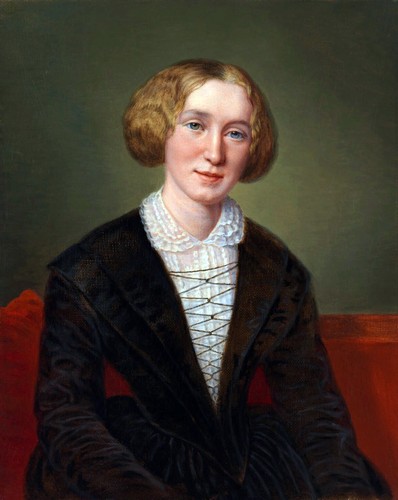
Discover
Nov 22, 1819 — Dec 22, 1880· 61 yrs

UNITED KINGDOM OF GREAT BRITAIN AND IRELAND AUTHOR · FICTION · SOCIAL LIFE AND CUSTOMS

George Eliot

Also known as: Mary Ann Evans, Mary Anne Mary Ann, Marian Evans

42
BOOKS
4.0
AVG RATING (19)
2
READERS

George Eliot, was an English novelist and one of the leading writers of the Victorian era. She is the author of seven novels, including The Mill on the Floss (1860), Silas Marner (1861), Middlemarch (1871–72), and Daniel Deronda (1876), most of them set in provincial England and well known for their realism and psychological insight.

Nuneaton, United Kingdom of Great Britain and Ireland
Wikipedia

A WIDE plain, where the broadening Floss hurries on between its green banks to the sea, and the loving tide, rushing to meet it, checks its passage with and impetuous embrace.

— from The Mill on the Floss, 1800

Most acclaimed

#2

George Eliot

1883

0.0 (0)

Mary Ann Evans (22 November 1819 – 22 December 1880; alternatively Mary Anne or Marian), known by her pen name George Eliot, was an English novelist, poet, journalist, translator, and one of the leading writers of the Victorian era. She wrote seven novels: Adam Bede (1859), The Mill on the Floss (1860), Silas Marner (1861), Romola (1862–1863), Felix Holt, the Radical (1866), Middlemarch (1871–1872) and Daniel Deronda (1876). Her novels are known for their realism, psychological insight, sense of place, and detailed depiction of the countryside. Middlemarch was described by the novelist Virginia Woolf as "one of the few English novels written for grown-up people" and by Martin Amis and Julian Barnes as the greatest novel in the English language. Scandalously and unconventionally for the era, she lived with the married George Henry Lewes as his conjugal partner, from 1854 to 1878, and called him her husband.

#1

The Mill on the Floss

1800

4.3 (8)

From the author of MIDDLEMARCH and SILAS MARNER, a story of frustrated intelligence and longing, featuring the intelligent Maggie, who yearns to be loved, and her brother Tom, who is forced to study. When Maggie is cast out by Tom, she is ostracized by society, and must face the consequences of renunciation.

#3

Complete poems

0.0 (0)

This volume of E.J. Pratt's selected poems introduces Pratt's poems to the college and university student, providing the background necessary for an informed reading of the poems. The volume offers a full sampling of Pratt's poems chosen both for their representativeness and for their intrinsic value. Included are the major long poems, The Witches' Brew, The Iron Door, The Titanic, Brébeuf and His Brethren, and Towards the Last Spike, and important shorter lyrics such as 'Newfoundland,' 'Come Away, Death,' and 'From Stone to Steel.' The editorial approach is historical, chronological, and biographical. The introduction locates E.J. Pratt in his Newfoundland and Canadian contexts, and discusses the development of his work in relation to his early modernist contemporaries, concluding that Pratt remains the most important and influential Canadian poet up to the mid-fifties. As such, he has been a key figure in shaping the Canadian literary imagination of his day and the later poetics of landscape adopted by Earle Birney and Margaret Atwood. The editors provide annotations, textual notes, and a biographical chronology. The printed volume is supplemented by the electronic resources of the Selected Pratt website at www.trentu.ca/pratt/selected.

Books

Newest First