
UNITED STATES AUTHOR · FICTION · HISTORY
Dalton Trumbo
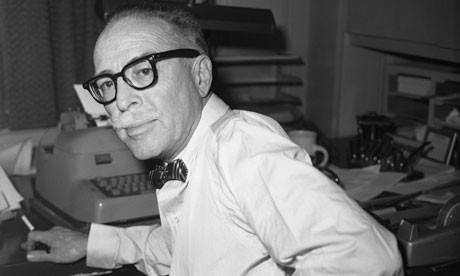
James Dalton Trumbo (December 9, 1905 – September 10, 1976) was an American screenwriter who scripted many award-winning films, including Thirty Seconds Over Tokyo (1944), Roman Holiday (1953), Spartacus (1960), and Exodus (1960). One of the Hollywood Ten, he refused to testify before the House Un-American Activities Committee (HUAC) in 1947 during the committee's investigation of Communist influences in the motion picture industry. Trumbo, the other members of the Hollywood Ten, and hundreds of other professionals in the industry were blacklisted by Hollywood. He continued working clandestinely on major films, writing under pseudonyms or other authors' names. His uncredited work won two Academy Awards for Best Story: for Roman Holiday (1953), which was presented to a front writer, and for The Brave One (1956), which was awarded to a pseudonym used by Trumbo.
At first it was a form.
— from Eclipse
Most acclaimed

Eclipse
"Alexander Cleave - a famous actor who "took to the stage to give myself a cast of characters to inhabit who would be ... of more weight and moment than I could ever hope to be" - faces the almost certain collapse of his thirty-year career. In physical and psychological retreat, he returns to his abandoned childhood home, believing that, away from his wife and daughter, away from the world at large, alone, without an audience of any kind, he might finally stop performing, catch himself in the act of living, and simply be.". "But the house is unexpectedly populated. There are Cleave's memories, which seem to rise up out of the house itself: of the years during his childhood when his mother took in boarders; of the beginnings, and the beginnings-of-the-end, of his career and his marriage; of the course of his relationship with his now estranged daughter; and of his father, who committed suicide when Cleave was still a boy. There are the corporeal, but illicit, inhabitants of the house: the caretaker, an unsettling presence "with the ageless aspect of a wastrel son," and the fifteen-year-old housekeeper, a "voluptuary of indolence." And there are the apparitions (ghosts? premonitions? visitations?) - a woman, a child, and a third, ill-defined figure - who Cleave feels are "intricately involved in the problem of whatever it is that has gone wrong with me."". "Struggling to determine what exactly has gone wrong, and to understand what part the apparitions play in his life and he in theirs, Cleave slowly comes to see the ways in which things and people - himself included - are not what they seem, and the ways in which, inevitably, they reveal what they are."--BOOK JACKET.
Spartacus
2005
Spartacus, a fictionalization of a slave revolt in ancient Rome in 71 B.C., is well known today partly because of the 1960 movie starring Kirk Douglas and Laurence Olivier. It was originally published in 1951 by the author himself, after being turned down by every mainstream publisher of the day because of Fast's blacklisting for his Communist Party sympathies. The story of Spartacus, born a slave, trained as a gladiator, who led a slave revolt that was eventually put down by Crassus, was immensely popular, has sold millions of copies, and has gone through nearly a hundred editions. The appearance of this title in the North Castle series brings back into print a book that many regard as a classic, and is enhanced with a new Introduction by the author.