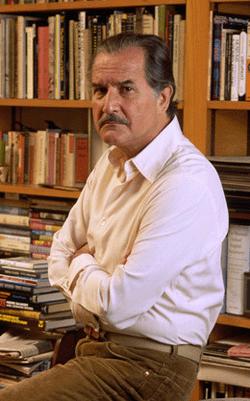
Carlos Fuentes
Personal Information
Description
Carlos Fuentes Macías (Ciudad de Panamá, 11 de noviembre de 1928-Ciudad de México, 15 de mayo de 2012) fue un escritor mexicano. Junto a Gabriel García Márquez, Mario Vargas Llosa y Julio Cortázar, es uno de los exponentes centrales del llamado boom latinoamericano. Entre sus novelas destacan La región más transparente, La muerte de Artemio Cruz y Aura. Recibió, entre otros, el Premio Rómulo Gallegos en 1977, el Cervantes en 1987 y el Príncipe de Asturias de las Letras en 1994. Hasta el día de su fallecimiento fue considerado candidato para obtener el Premio Nobel de Literatura por un sector del público y de la crítica literaria.
Books
Obras reunidas
Gathers the works of the noted Mexican novelist and author of historical and critical works.
Destiny and Desire
Three young women journey to the glorious city of San Francisco determined to follow their passions and dreams as the United States plunges itself into World War I
Inframundo
Este libro es un homenaje a Juan Rulfo, autor de obras fundamentales en la literatura latinoamericana, como El llano en llamas y Pedro Páramo. Incluye fotografías de Rulfo que capturan la esencia de un México marcado por la pobreza y el drama, así como reflexiones de destacados escritores sobre su vida y obra. La primera edición fue publicada por el Instituto Nacional de Bellas Artes de México con el título de Juan Rulfo: Homenaje nacional. Las siguientes ediciones, publicadas por Ediciones del Norte, llevaron el título de Inframundo: El México de Juan Rulfo (versión en español), e Inframundo: The Mexico of Juan Rulfo (versión en inglés).
Juan Rulfo
Juan Rulfo has published only three slender volumes of fiction, yet his name has become well known throughout the literary world. The fact that his works capture the very essence of Mexico, its geography, its people, may explain his popularity. My purpose here is to present as complete a study of Rulfo's life and works as possible.
The great Latin American novel
"One of the late Carlos Fuentes's final projects, this compendium of his criticism traces the evolution of the Latin American novel from the discovery of America to the present day. Combining historical perspective with personal and often opinionated interpretation, Fuentes gives us a tour from Machado de Assis to Borges and beyond. A landmark analysis, as well as a scintillating and often wry commentary on a great author's peers and influences, this book is as much a contribution to Latin American literature as it is a chronicle of that literature's greatest achievements" --
Adam en Éden
Lorsqu'Adam Gorozpe décide de s'en prendre aux cartels de drogue mexicains, il ignore qu'il s'agit d'un aller simple pour l'enfer. Face à lui, l'impitoyable Adam Gongora, chef corrompu de la sécurité nationale mexicaine à la stratégie terrifiante : s'allier aux criminels, enfermer les plus faibles et, grâce à ces arrestations faciles d'innocents, gagner les faveurs de l'opinion publique. Pour survivre dans ce duel sans foi ni loi, Adam Gorozpe n'a d'autre choix que d'appliquer les mêmes règles du jeu que son adversaire et de se faire plus criminel que les criminels. Dès lors, les limites sociales, éthiques et humaines n'existent plus. Les deux hommes s'affrontent dans un monde où le pouvoir et la cupidité exigent la soumission ou la mort. [4e de couverture] Roman de société
The crystal frontier
Nine stories dealing with U.S.-Mexico relations. In the title story, a Mexican window washer meets an American executive, Girlfriends is about a Mexican maid and her racist Anglo employer, and Rio Grande, Rio Bravo is on border crossings. Description: 266 p. ; 22 cm. Contents: A capital girl -- Pain -- Spoils -- The line of oblivion -- Malintzin of the maquilas -- Las amigas -- The crystal frontier -- The bet -- Río Grande, Río Bravo. Other Titles: Capital girl. Line of oblivion. Amigas. Crystal frontier. Bet. Frontera de cristal. Responsibility: Carlos Fuentes ; translated from the Spanish by Alfred Mac Adam. Abstract: The nine stories comprising this novel all concern people who in one way or another have had something to do with, or still are part of, the family of a powerful oligarch of northern Mexico with manifold connections to the United States. Each story concerns a Mexican-American encounter--sometimes hilarious, often tragic, frequently ambivalent, inevitably poignant--and each unique drama in its own way epitomizes some striking contrast along the invisible, reflective, dangerous frontier that divides the American-Mexican world. Beyond the emblematic power of Mr. Fuentes's exuberant fiction to make us think about the political and cultural themes which affect and distort that double world, there is the sheer human diversity of life on "crystal frontier." These stories pulse with vivid experience--of love in its many guises, of loneliness, of youth and age, of heartbreak and redemption.--From publisher description.
Nuevo tiempo mexicano
"Series of 12 essays on Mexican culture, history, and politics, originally published as Nuevo tiempo mexicano (1994). Time and memory are recurring motifs connecting essays. Some autobiographical chapters. Several centered on Mexico's 1994 political crossroads are somewhat dated given the outcome of the 2000 elections. Fluent translation; no supporting or introductory materials"--Handbook of Latin American Studies, v. 58.
Contos Naturais
After his first work, Los días enmascarados, was published in 1954, it became clear to all that Carlos Fuentes is one of the contemporary masters in the art of short story writing.
Muerte de Artemio Cruz
An imaginative portrait of an unscrupulous individual, the story also serves as commentary on Mexican society, most notably on the abuse of power--a theme that runs throughout Fuentes' work. As the novel opens, Artemio Cruz, former revolutionary turned capitalist, lies on his deathbed. He drifts in and out of consciousness, and when he is conscious his mind wanders between past and present. The story reveals that Cruz became rich through treachery, bribery, corruption, and ruthlessness. As a young man he had been full of revolutionary ideals. Acts committed as a means of self-preservation soon developed into a way of life based on opportunism. A fully realized character, Cruz can also be seen as a symbol of Mexico's quest for wealth at the expense of moral values.
Diana, the goddess who hunts alone
"Fuentes' novel (see HLAS 56:3488) recounts a 1970 love affair between a Mexican writer and a North American movie actress against the backdrop of FBI political repression and its brutal consequences. Reflections on sex, love, literature, Latin and North American culture, and Cold War politics. Excellent translation by Mac Adam. No supporting materials"--Handbook of Latin American Studies, v. 58.
